A developer asks an AI assistant for an API endpoint. A few seconds later, there is working code on the screen. It compiles, the test request works, and everyone saves some time.
Then somebody asks the less exciting question. Is any of that code actually safe?
That question is becoming harder to ignore as AI coding tools get pushed deeper into everyday development. Teams now use them for boilerplate code, test cases, bug fixes, documentation, and complete functions.
Research published in 2026 gives us a useful reality check. One study examined 2,315 real C, C++, and C# snippets connected with GPT use. Researchers confirmed 56 security vulnerabilities across 48 files after static scanning and manual review.
Later, GPT-4.1, GPT-5, and Claude Opus 4.1 were asked to find those problems. The newer models found between 44 and 46 of the 56 confirmed vulnerabilities. That is impressive progress.
It is also not enough for production code.
Knowing AI Wrote Code Does Not Tell You If It Is Safe
This is where an AI detector can easily get more credit than it deserves.
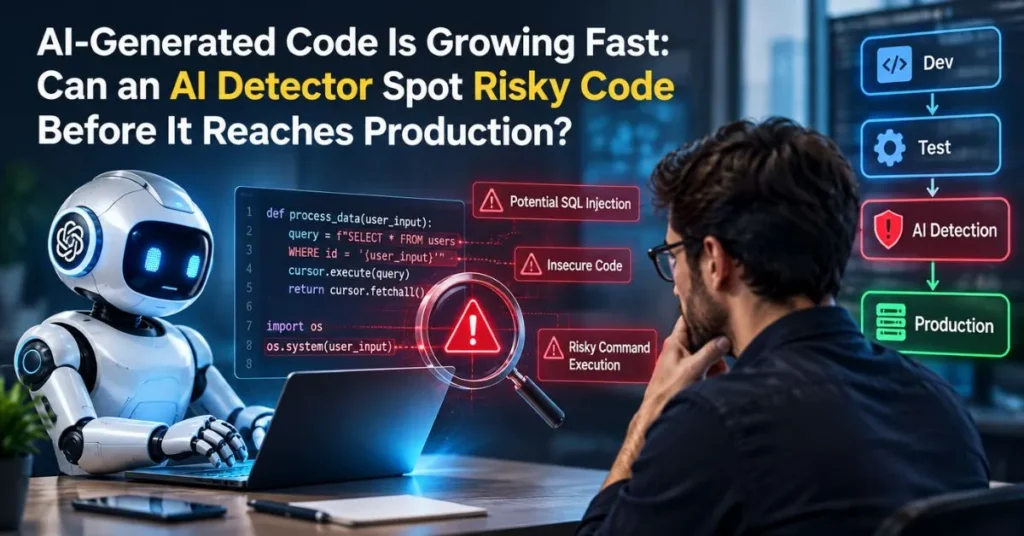
Suppose your pull request contains several hundred lines. A detection tool may tell you that some sections were probably generated through an AI coding assistant.
Fine. Now what? You still have no answer about SQL injection. You still do not know if authentication fails under unusual requests. You have no idea if a secret token ended up inside the repository.
Authorship and security are two separate questions. A human developer can write terrible code after lunch. An AI assistant can produce perfectly acceptable code before breakfast. Your security process has to judge what the code actually does.
When reviewing generated code, ask practical questions instead:
● Can untrusted input reach a database query?
● Are credentials stored directly inside source files?
● Can uploaded files access sensitive directories?
● Does authentication reject unexpected requests correctly?
● Are permissions wider than the application needs?
● Did the assistant add a package nobody reviewed?
Those questions lead you toward real problems.
AI Reviewing AI Can Still Miss Important Bugs
There is another tempting shortcut developers should treat carefully.
You can ask one AI system to write code. Then you can ask another AI system to review it. It sounds efficient.
Research on GitHub Copilot code review published in 2026 found important gaps during security testing. Copilot missed vulnerabilities involving SQL injection and cross-site scripting in several test cases. Insecure deserialization caused problems as well.
Think about how this works during a normal development day. An assistant writes a function. The function compiles. Another automated tool reviews the pull request and gives you a reassuring answer.
Everyone wants to merge. A missed vulnerability does not become safer because two systems approved it.
Another recent study involving Copilot users reached a similar conclusion. Researchers found insecure code among both newer and experienced developers. Copilot helped with certain vulnerability types, but security did not improve across every participant. Human experience still earns its place here.
Companies Are Already Worried About This Problem
Security teams are not treating AI code as some distant issue anymore. Docker’s 2026 software supply chain research surveyed 400 IT and security professionals across North America. Around 40 percent named AI technology as their biggest software supply chain risk.
Third-party code came just behind at 39 percent. The same research found that 77 percent of surveyed organizations experienced a software supply chain incident during the previous twelve months.
Another number deserves attention. About 35 percent worried that AI tools could bring more vulnerable code into their systems. You can understand why.
A developer can accept dozens of suggestions during one coding session. That speed is useful until review gets skipped because everything arrived too quickly. Nobody has time to inspect 200 lines properly after treating them as harmless autocomplete.
Treat Generated Code Like Work From Someone New
There is a simple rule your team can use tomorrow. Treat generated code like code submitted by a developer nobody on the team knows yet.
You do not need to distrust every line. You also should not approve code simply because it runs successfully.
Send it through the same process as everything else. Run static security testing against the new code. Check dependencies before they enter your project. Scan the repository for exposed credentials. Then test unexpected inputs.
Your CI pipeline can stop a pull request when critical findings show up. A developer can investigate before the change reaches a production branch. This is where an AI detector can still have a role.
Your company may want to know where generated code entered the repository. Some teams may require additional review for machine-written sections under internal development policies.
This information can help with governance. It should never replace security testing.
AI-Suggested Packages Need Extra Checking
Generated code is only part of the risk. Coding assistants also recommend dependencies when developers ask them to fix errors or add features. This can go badly.
A model may suggest an outdated package. It may recommend something with known vulnerabilities. In stranger cases, it can provide a package name that does not actually exist. Attackers already take advantage of confusing package names.
Sonatype’s 2026 software supply chain research warns that AI coding systems can introduce dependencies while trying to solve build problems. If nobody checks where those packages came from, a quick fix can open another security problem.
Before adding an AI-suggested package, check a few basic things:
● Confirm the package exists in the official registry.
● Check who actually publishes the package.
● Review recent maintenance and release activity.
● Search known vulnerability databases first.
● Confirm your organization allows that dependency.
This takes far less time than dealing with a compromised build later.
Production Code Needs Proof
AI coding assistants are getting better at finding security problems. Finding around 80 percent of known vulnerabilities in a controlled test is meaningful progress. Developers should absolutely pay attention to that improvement. But think about the other 20 percent.
If one missed issue exposes customer records, nobody will care that the model caught four other bugs first. Your users do not care who wrote the vulnerable function either. They care that their information was exposed.
Use AI where it saves you real time. Let it draft repetitive code. Ask it for test ideas. Use it to explain unfamiliar functions when you inherit an older project.
After that, treat its output like code. Review it yourself. Scan it properly. Test what happens when input gets weird. Knowing that AI probably wrote a function may satisfy an internal policy.
Knowing that the function cannot damage your production system is the answer your team actually needs.