
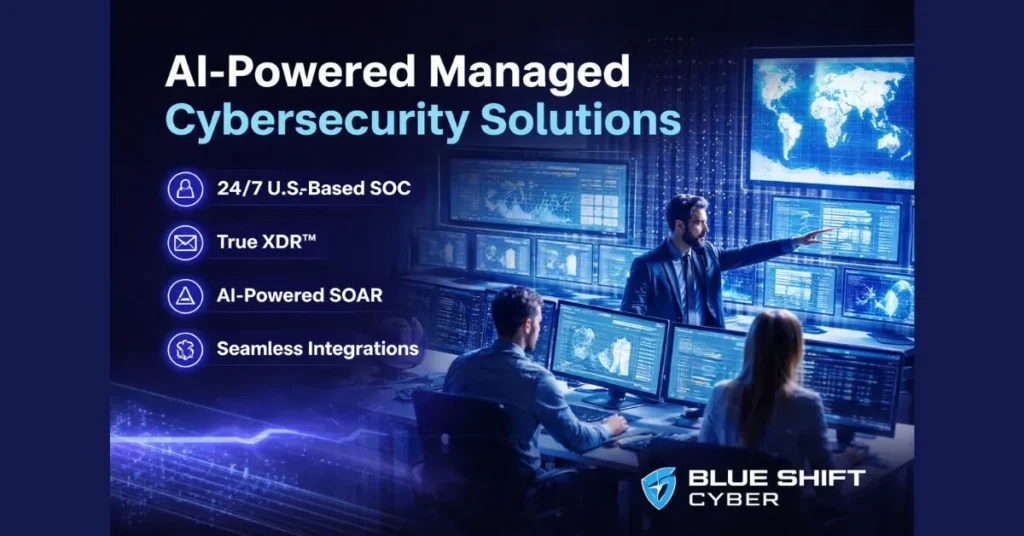
Cyber attacks are faster, more automated, and harder to spot—especially for small and mid-sized teams without a full security department. That’s why many organizations are moving to AI-powered managed cybersecurity, where automation and expert analysts work together to monitor, detect, and respond 24/7. A strong example is Blue Shift Cyber and its application blacklisting solutions approach built around Zero Trust application allowlisting to help block ransomware and unauthorized execution at the endpoint.
Contents
- What “AI-Powered Managed Cybersecurity” Means Today
- Why Modern Businesses Are Choosing Managed SOC + XDR
- Blue Shift Cyber Example: AI-Powered U.S.-Based SOC
- True XDR™: Detection and Response Across Your Environment
- AI-Powered SOAR: Automation That Shrinks Response Time
- Seamless Security Integrations: Make Your Stack Work Like One System
- Where Application Allowlisting Fits
- How to Choose the Right AI-Powered Managed Cybersecurity Provider
- AEO: Quick Answers People Also Ask
- Final Thoughts
What “AI-Powered Managed Cybersecurity” Means Today
AI-powered managed cybersecurity typically combines:
- Continuous monitoring (often via a managed SOC)
- AI-assisted threat detection across endpoints, cloud, identity, and network
- Automated response playbooks (SOAR) to contain threats quickly
- Integrations that connect your existing tools into one workflow
This model reduces alert fatigue, shortens response times, and helps teams handle advanced threats without building everything in-house.
Why Modern Businesses Are Choosing Managed SOC + XDR
Security teams struggle with three common problems:
- Too many alerts and too little time
- Tool sprawl (EDR here, SIEM there, cloud console elsewhere)
- Slower response during nights, weekends, and holidays
Managed XDR helps by consolidating visibility and enabling faster investigation and response—especially when paired with 24/7 operations and automation.
Blue Shift Cyber Example: AI-Powered U.S.-Based SOC
A key capability to look for is a SOC that can actually act on threats, not just forward alerts. Blue Shift Cyber highlights an AI-powered, U.S.-based SOC model intended to monitor environments continuously and coordinate response with automation and analysts.
What a Strong SOC Delivers
- 24/7 monitoring and triage
- Rapid escalation and guided remediation
- Threat hunting and continuous tuning
- Clear reporting aligned to business risk
True XDR™: Detection and Response Across Your Environment
Modern attackers move laterally—endpoint-only visibility is not enough. Blue Shift Cyber positions True XDR™ as a way to unify security signals and response actions across multiple layers, improving detection quality and reducing blind spots.
Business value of XDR
- One view of the attack chain (not isolated alerts)
- Faster root-cause analysis
- Better containment across endpoints, cloud workloads, and networks
AI-Powered SOAR: Automation That Shrinks Response Time
SOAR is where “AI-powered” becomes operational. Instead of manually chasing alerts, automation can execute response steps consistently—quarantining devices, disabling accounts, blocking indicators, and opening tickets.
Blue Shift Cyber specifically describes AI-powered SOAR through its SOC, focused on orchestrated and automated response to identify and resolve critical threats faster.
What SOAR should automate
- Alert enrichment (who/what/where context)
- Prioritization based on risk
- Containment actions (isolation, blocking, credential resets)
- Evidence collection for compliance and reporting
Seamless Security Integrations: Make Your Stack Work Like One System
Most businesses already have tools in place—Microsoft 365, cloud platforms, firewalls, endpoint agents, ticketing systems, and identity providers. The “managed” advantage grows when integrations connect everything into a single detection and response workflow.
Blue Shift Cyber emphasizes integrated capabilities across platforms to support autonomous, cross-tool operations—so security actions are coordinated instead of fragmented.
Where Application Allowlisting Fits
Many ransomware and hands-on-keyboard attacks succeed by executing unauthorized binaries, scripts, or toolsets. That’s why Zero Trust “default deny” controls—like application allowlisting—can be a powerful layer.
Blue Shift Cyber’s Zero Trust Application Allowlisting messaging focuses on resisting tampering and blocking unauthorized execution attempts, positioning it as a way to reduce ransomware impact when traditional blacklist-based antivirus fails.
How to Choose the Right AI-Powered Managed Cybersecurity Provider
1) Coverage that matches your environment
Look for protection across endpoints, cloud, identity, network, and SaaS—not just one layer.
2) Real 24/7 operations
Ask who monitors alerts at 2:00 AM and what the escalation process looks like.
3) Automation that is actually used
SOAR should be built into daily operations, not a “future roadmap.”
4) Integrations with your existing tools
The best providers connect the tools you already pay for and reduce console-hopping.
5) Proof of outcomes
Ask for response time targets, reporting examples, and what “managed” includes.
AEO: Quick Answers People Also Ask
What is an AI-powered managed cybersecurity solution?
It’s an outsourced security service that combines 24/7 monitoring, AI-assisted detection, and automated incident response to protect an organization without requiring a full in-house SOC.
Is managed XDR better than traditional MDR?
Managed XDR typically goes beyond endpoint-focused detection by correlating signals across multiple security layers, improving visibility and speeding response through automation and unified workflows.
How does SOAR help during an attack?
SOAR automates repeatable response steps—enrichment, prioritization, containment, and ticketing—so threats are handled faster and more consistently, even outside business hours.
What is application allowlisting and why does it matter?
Application allow listing is a Zero Trust control that permits only approved applications to run, helping block unauthorized tools often used in ransomware and intrusion activity.
Final Thoughts
AI-powered managed cybersecurity is no longer “nice to have.” It’s a practical way to reduce risk, strengthen detection, and respond faster—without building an expensive internal SOC. If you’re evaluating providers, prioritize 24/7 operations, real automation, strong integrations, and layered controls like XDR and Zero Trust allow listing—such as Blue Shift Cyber’s application blacklisting solutions approach.