
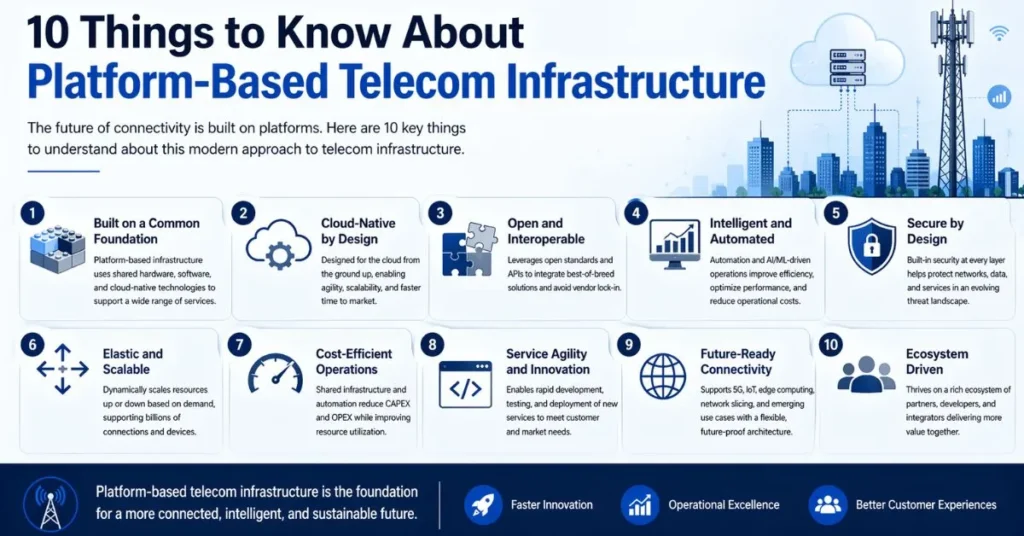
Platform-based telecom infrastructure is changing how wireless services get built and run. Instead of stitching together a long list of one-off systems, many operators and brands are moving toward reusable software building blocks that support onboarding, provisioning, billing, policy, analytics, and support workflows.
To shape this article, public telecom standards and industry references on 5G core architecture, open APIs, and Open RAN specifications were reviewed. The most practical takeaways were organized into a buyer-friendly checklist.
What “platform-based” means for modern telecom teams
Platform-based telecom infrastructure is a setup where core capabilities are packaged as repeatable services and exposed through APIs. It is designed so teams can launch new plans, partners, geographies, and even new brands without rebuilding the back office every time.
One common component in many launches is a Mobile Virtual Network Enabler (MVNE), a provider layer that helps mobile brands operate without owning the full network stack. In platform terms, this can include subscriber provisioning workflows, SIM lifecycle management, rating and charging hooks, product catalog logic, and integrations into customer care and billing systems. The exact scope varies by MVNE model and host operator, but when the enablement layer is well-designed, it can reduce the time and effort required to move from a business idea to an active subscriber.
From there, the platform approach extends across the entire service lifecycle. A strong platform is not just a collection of tools; it is a consistent operating model that makes changes safer, faster, and easier to track.
10 things to know before choosing or building a telecom platform
- APIs are the operational backbone
Most platforms look similar in slide decks. The difference shows up when systems need to connect and evolve. Ordering, CRM, billing, support, number management, and analytics should integrate through stable APIs, clear data models, and predictable versioning. If integrations rely on custom scripts or fragile file drops, every new offer can turn into a mini project. - Cloud-native is about automation, not location
Hosting software in a cloud does not automatically make it cloud-native. Telecom-grade platforms should support automated deployment, scaling, monitoring, and rollbacks. Look for containerization, repeatable environments, and strong observability so problems can be detected quickly and fixed with controlled changes. - Multi-tenancy needs clean separation
If the platform will support multiple brands or partners, tenant separation has to be real. That includes isolated data, configurable policies, role-based access, and clear reporting boundaries. Ask how upgrades work across tenants, how configuration drift is prevented, and what happens when one tenant’s traffic spikes. - 5G architecture pushes platforms toward modularity
Modern mobile cores are built around modular network functions and service-based interfaces. That design supports more flexible integration patterns and makes it easier to evolve capabilities without replacing everything at once. A platform strategy should align with that reality, even if the rollout happens in phases and includes legacy interworking. - Hybrid operations are normal, not an exception
Many deployments blend older and newer network elements during transition periods. The platform should handle migrations and coexistence scenarios, not just a clean greenfield setup. This is especially relevant for provisioning, policy enforcement, roaming dependencies, and device compatibility across multiple generations of network behavior. - Provisioning is often where “speed to launch” breaks down
Fast launches depend on accurate, automated provisioning. That means predictable workflows for SIM activation, number assignment, policy application, and service entitlements. Evaluate how exceptions are handled, how retries work, how failures are surfaced to operations teams, and how the platform confirms that network state matches billing and product state. - Billing and charging are hard to retrofit later
Billing is not just about invoices. It includes rating, charging triggers, taxes, discounts, proration rules, top-ups, refunds, credits, and dispute handling. A platform should support product changes without corrupting historical records, and it should make reconciliation straightforward so teams can match what a customer used to what they were charged. - Open RAN is related, but it is a different layer
Open RAN focuses on RAN disaggregation and interoperability, especially open interfaces between RAN components and more flexible deployment models. Platform-based infrastructure often sits above that, connecting core, orchestration, OSS/BSS, and partner systems. If Open RAN is part of the plan, make sure the platform can ingest RAN performance and fault data reliably, correlate it with subscriber and service context, and translate signals into operational actions. - Security and compliance are daily operations, not a checkbox
Telecom systems touch identity, payments, and sensitive customer data. Strong platforms include encryption, key management, audit logging, vulnerability management, and strict access controls. Also check partner governance and supply chain practices, since platform models often bring more third parties into critical workflows. - A platform should make performance and profitability visible
Good dashboards cover more than network throughput. Teams should be able to see activations, churn, usage patterns, support drivers, plan performance, and margin signals in one place. If reporting is weak, decisions slow down, root causes get missed, and commercial mistakes become more expensive.
Turn infrastructure into a repeatable launch engine
The best platform-based telecom infrastructure supports change without chaos. It gives teams a stable foundation for onboarding partners, releasing new plans, and improving operations while maintaining reliability. When the evaluation focuses on integration depth, provisioning rigor, billing maturity, tenant design, and security posture, the platform becomes an engine for growth rather than a pile of tools that requires constant babysitting. For many wireless brands, the right MVNE layer can also be part of that engine, especially when the goal is to launch faster while avoiding unnecessary infrastructure burdens.